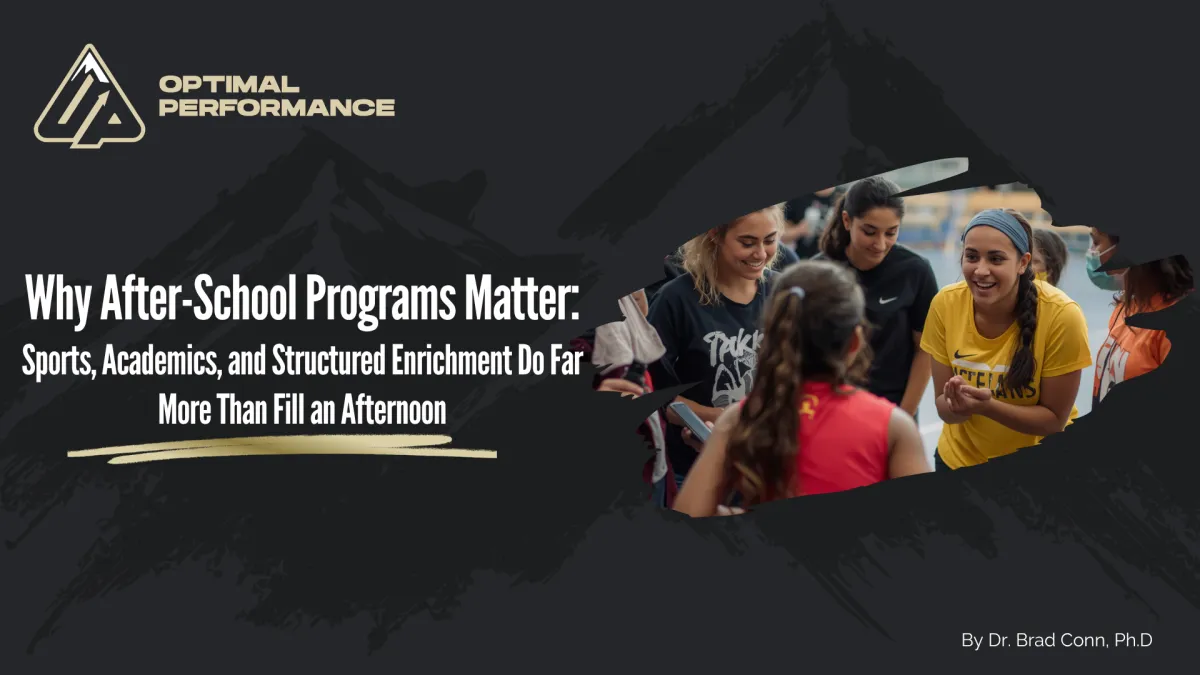
Why After-School Programs Matter: Sports, Academics, and Structured Enrichment Do Far More Than Fill an Afternoon
When the final bell rings, what happens next matters, perhaps more than we realize. For millions of adolescents, the hours between 3 p.m. and dinnertime are either a structured bridge to their future or an unsupervised void that can pull them in the wrong direction. After-school programs, whether organized around athletics, academics, or life skills training, represent one of the most powerful and underappreciated tools in youth development.
A study I published in the Journal of Performance Psychology (Conn, Plotkin, & Noviello, 2024) offers compelling empirical support for this claim, and the findings go far beyond GPA scores and graduation rates. The research, which I originally completed for my doctoral dissertation and later replicated with a doctoral student examined adolescents participating in an after-school program in Los Angeles called World Fit for Kids, a program centered on physical activity, leadership, and job readiness. We compared those participants to a group of similar-age students enrolled in college courses at Compton College.
“After-school programs are potentially valuable not only for job skills training but for psychological wellbeing.” — Conn, Plotkin, & Noviello (2024)
The Study: At-Risk Youth and the Psychology of Work Effort
We examined 41 at-risk adolescents (ages 15–18) participating in World Fit for Kids (WFIT), a Los Angeles-based nonprofit after-school program centered on physical activity, life skills, and employment readiness. A comparison group of 47 similar-age students enrolled in college courses at Compton College served as the control.
The goal was to identify which psychological factors of self-esteem, empowerment, race, age, gender predicted changes in work effort over the course of the program. Work effort was measured across three dimensions: direction (where you invest energy), intensity (how hard you push), and persistence (how long you keep going).
What did we find? Demographics alone — race, age, and gender — had no significant effect on changes in work effort. The real drivers were psychological: empowerment, and particularly a sense of competence. When adolescents felt capable and in control, their motivation to work harder increased measurably.
Why Empowerment — Not Just Self-Esteem — Is the Key
Popular thinking often treats self-esteem as the magic ingredient for youth success. This study complicates that picture in an important way. While self-esteem did matter, it only drove work effort when competence was relatively low. In other words, when youth already believed in their abilities, self-esteem became less critical. When they doubted themselves, self-worth stepped in as a psychological safety net.
The more consistent predictor across the board was empowerment — particularly the belief that one’s efforts can produce real outcomes (competence) and that one has genuine influence over one’s own life (impact). These findings align with decades of motivational research suggesting that intrinsic psychological factors, not demographic characteristics, are the true engines of adolescent performance.
For practitioners — coaches, counselors, teachers, and program directors — the takeaway is clear: structured after-school environments that cultivate a sense of agency and capability in young people are doing something profoundly important.
The Bigger Picture: What’s at Stake
California’s urban schools face serious funding challenges, and after-school programs have been among the first casualties. There is currently a proposal to eliminate all after-school programs in Los Angeles following the 2025–2026 fiscal year — a decision that, viewed through the lens of this research, could carry significant psychological costs.
The LAUSD’s 2022–2023 graduation rate of approximately 85% remains below both the California state average (87%) and the national average (88%). Research suggests that the absence of structured after-school programming is a contributing factor in elevated dropout rates, particularly for at-risk youth who already face greater levels of chronic mental distress (Brown et al., 2020; Peetz & Baker, 2023).
After-school programs — whether they’re about free throws or fractions — provide more than skill development. They offer belonging, mentorship, routine, and the lived experience of being capable. These are psychological necessities, not luxuries.
Implications for Performance Psychology
From a performance psychology standpoint, the WFIT study reinforces a core principle: sustained effort and motivation are built on psychological foundations, not demographic fate. Programs that embed empowerment into their design which give youth real responsibilities, meaningful feedback, and opportunities to see themselves as capable are building the intrinsic motivation infrastructure that no standardized test can assess.
Sports-based programs are particularly well-positioned to deliver this. When an adolescent takes on the role of youth coach, as WFIT participants do, they experience firsthand the cycle of competence: they try, they lead, they see results, and they believe in themselves more deeply. Since 2006, WFIT has documented a 51% increase in participants’ GPA, and many alumni have returned as coaches themselves, a testament to the program’s long-term psychological impact.
Whether the program is on a court, a field, or in a classroom, the psychological benefits of structured after-school participation are real, measurable, and consequential. As we continue to debate education funding and community investment, policymakers, administrators, and practitioners would do well to recognize that when we cut after-school programs, we are not simply cutting extracurriculars, we are cutting one of the most cost-effective mental health and motivation interventions we have.
References
Conn, B. E., Plotkin, I., & Noviello, N. (2024). Interventions for at-risk adolescents: Self-esteem and empowerment as predictors of increased work effort. Journal of Performance Psychology, 18. https://www.nu.edu/wp-content/uploads/2024/11/Journal-of-Performance-Psychology-Issue-18.pdf
Brown, S. M., Doom, J. R., Lechuga-Peña, S., Watamura, S. E., & Koppels, T. (2020). Stress and parenting during the global COVID-19 pandemic. Child Abuse & Neglect, 110, 104699.
Peetz, M., & Baker, B. (2023). After-school program dropout rates and their relation to educational outcomes. Urban Education Review, 14(2), 45–63.
Scales, P. C., Benson, P. L., & Mannes, M. (2010). Effectiveness of developmental assets-based programs. Journal of Early Adolescence, 30(1), 12–32.
Spreitzer, G. M. (1995). Psychological empowerment in the workplace: Dimensions, measurement, and validation. Academy of Management Journal, 38(5), 1442–1465.
A World Fit for Kids! (n.d.). About us. https://worldfitforkids.org/about-us/