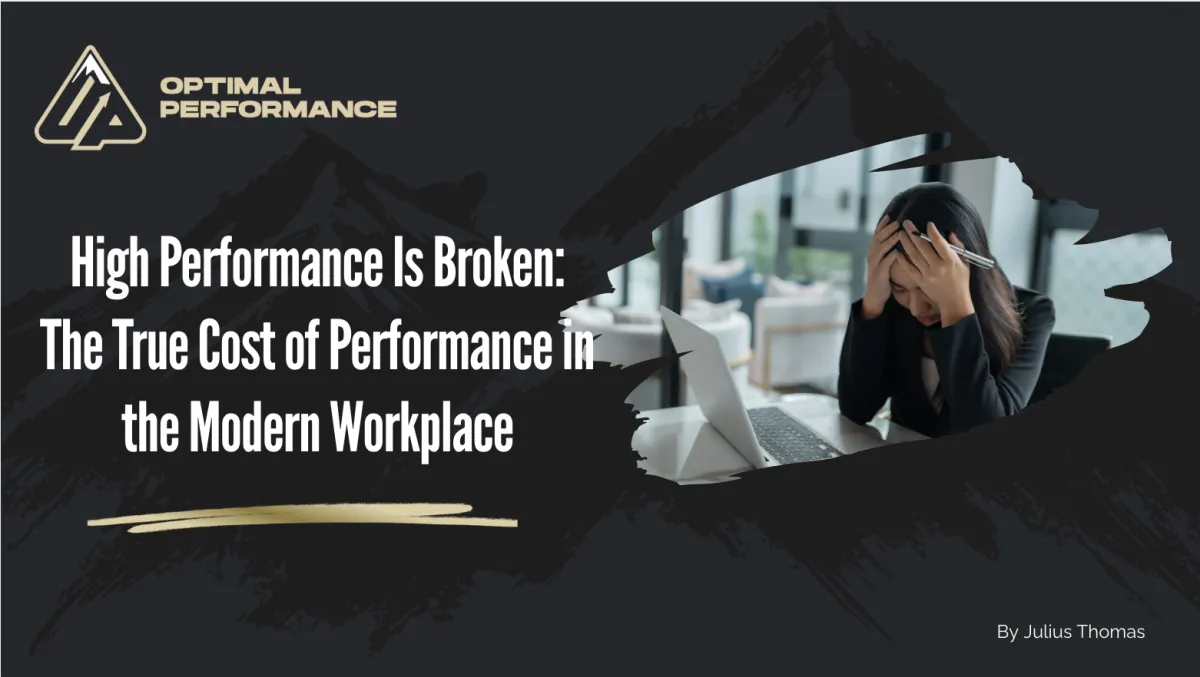
High Performance Is Broken:The True Cost of Performance in the Modern Workplace
Executive Summary
High performance is often portrayed as the pinnacle of organizational success. But behind the metrics, revenue growth, and productivity dashboards lies a systemic crisis: the hidden and rising Cost of Performance (reduced mental health, physical health, emotional health, and relational health). This cost, expressed in burnout, chronic disease, disengagement, and talent attrition, should not be a wellness-related afterthought. It should be seen as a corporate performance opportunity, because it is a bottom-line business problem.
Millennials and Gen Z, who now make up the majority of the workforce, are actively seeking organizations that prioritize their mental wellbeing. According to Gallup and Deloitte surveys, younger workers are more likely to leave jobs that ignore wellbeing and more likely to stay and thrive in environments that support it. Meanwhile, productivity and revenue potential are being left on the table by teams whose mindsets, stress levels, and health behaviors are misaligned with optimal output. The symptoms of poor employee mental health: missed work, disengagement, workers comp claims, and turnover are costing companies billions annually. This is not simply a wellness initiative. This is an enterprise performance strategy.
The Overlooked High Performance Data
GDP vs. GWB
While global GDP has steadily increased, health and wellbeing has not kept pace.
Depression now accounts for up to $51B in lost productivity annually in the U.S. alone (NIH/CDC).
Over 200 million workdays are lost each year due to mental health disorders (CDC).
Burnout affects nearly 50% of Gen Z and 40% of older professionals (CNBC).
Job stress costs U.S. companies over $300B annually (UML Research).
These numbers aren’t just health stats, they are indicators of lost potential revenue.
What Created the Cost of Performance?
Leaders Need a New Playbook
Leaders in marketing, finance, and sales have not been trained in sports mental performance or how to manage team mental health. They need consulting support and evidence-based systems to help them understand new scientific findings that can be applied to create elite teams.Performance Systems Without Behavioral Health Foundations
High performers are trained for output, not for sustainability. They have not been trained in how to manage their daily behaviors while at work and outside of work to maintain their peak performance. They need education and practical systems to help exert themselves to reach organizational goals while maintaining the essential components of wellbeing.Minimal Investment in Core Performance Drivers
There is minimal investment in education related to behavioral health components that drive performance. Sleep science, recovery models, mental health literacy, or stress resilience—despite overwhelming data linking them to cognitive output.Lack of Integration
Performance and wellbeing initiatives are siloed. Rarely do companies train and measure performance and health outcomes together to determine ROI.
The Four Quadrants of Optimal Performance
The Optimal Performance Corporate System (OPCS) was designed to address the broken high-performance culture of our time. It provides a unified, teachable, and evidence-based framework built around four pillars:
IWB - Individual Wellbeing
Behavioral health, stress resilience, mental health preventionIP - Individual Performance
Mindset, vision, goals, performance behaviorsTWB - Team Wellbeing
Psychological safety, positive emotional culture, burnout preventionTP - Team Performance
Communication, accountability, cohesion, clear goals, shared mission, and team performance behaviors
What Leaders Can Do
Provide Education: Teach individual performance, preventative health behaviors, mentally healthy culture, and team accountability in one integrated model.
Invest in The Mind: Mental performance is not supposed to be easy. Build systems and environments that sustain it, not just extract it.
Redefine ROI: Be aware of the cost mental performance reductions and mental health strain are having on the bottom line.
Add an Expert to the Team: High-performing sports organizations integrate multiple performance scientists in their ecosystems. Optimal Performance works collaboratively with HR to enhance team effectiveness, by adding elite performance learnings and the most up to date psychological science.
Conclusion
High performance is not broken because people are lazy. It’s broken because the systems and strategies we use today have not been updated with new findings in performance and behavioral science. The OPCS framework is here to propel high-performing organizations into the future. Bringing peak performance and behavioral health into alignment. So organizations and high performers can push beyond the limits of what has been done, and do it without sacrificing what matters most.
Because the real competitive advantage isn’t just working harder. It’s sustaining excellence while protecting the health-span of your people.
Optimal Performance = Maximum Performance + Maximum Wellbeing


