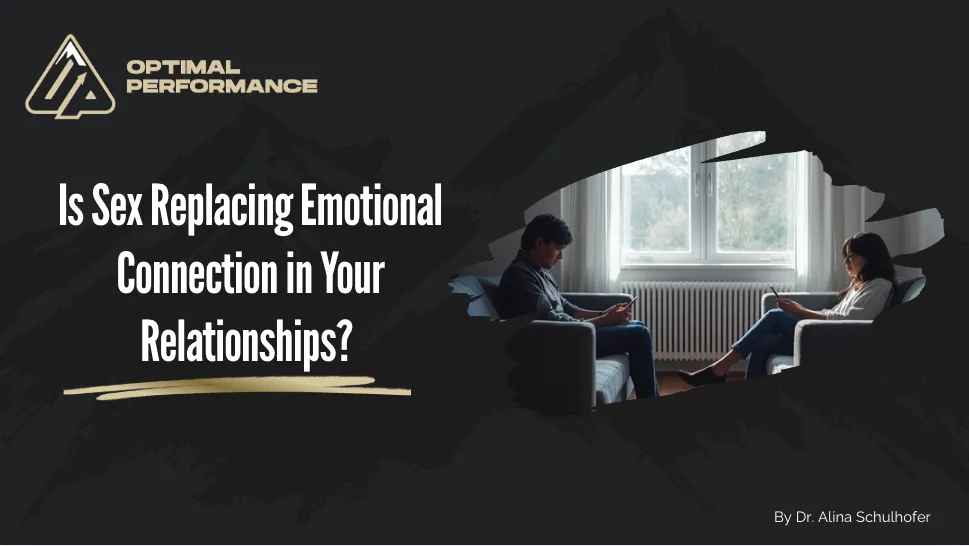
How Sexual Intimacy Can Become a Substitute for Emotional Closeness
Sexual intimacy and emotional intimacy are often assumed to naturally go together. In many relationships, they do. But it is not uncommon for sexual closeness to become a substitute for emotional closeness rather than an extension of it. When this happens, physical intimacy can feel intense, validating, and even deeply bonding, yet still leave us feeling empty or alone.
For many, sexual intimacy serves not only relational or pleasurable purposes, but also represents an important self-regulating function. Physical closeness can provide reassurance, temporary relief from stress, or a sense of feeling wanted and valued. In high-stress roles, being expected to remain composed and emotionally contained, sexual intimacy can become one of the few spaces where tension is released and a degree of vulnerability feels permitted.
Unlike emotional intimacy, which requires the capacity to tolerate openness, uncertainty, and emotional exposure, sexual intimacy can offer a more immediate and predictable form of closeness. Emotional connection often involves revealing fears, insecurities, or unmet needs that may feel difficult to tolerate or articulate. Sexual connection, by contrast, can create a sense of closeness without requiring the same depth of emotional vulnerability. For those of us who have learned to rely heavily on independence, performance, or self-sufficiency, physical intimacy may feel far safer than emotional vulnerability.
When sexual intimacy becomes the primary way connection is experienced, relationships may organize themselves around moments of intensity and closeness during physical intimacy, followed by emotional distance or disconnection outside of it. We may feel physically close to another person, yet struggle to feel emotionally known, understood, or met.
Over time, this dynamic often creates subtle but persistent challenges. When emotional needs are repeatedly avoided, we may experience an underlying sense of emptiness, sadness, or disconnection, even in the presence of frequent physical intimacy. While there may be a longing to be seen, understood, or met on a deeper level, we may feel uncertain about how to access or express those needs. Emotional closeness can feel unfamiliar, uncomfortable, or even risky.
Sexual intimacy can also function as a powerful stress-management strategy. In high-pressure environments in particular, we often experience chronic levels of responsibility and emotional suppression. Physical intimacy can temporarily reduce anxiety, restore a sense of control, or counteract feelings of self-doubt. Despite these desirable effects, difficulties tend to arise when sexual connection becomes one of the only reliable ways we manage emotional distress or maintain a sense of connection.
In therapy, many begin to recognize how sexual intimacy has served as a way to cope with loneliness, pressure, or feelings of inadequacy, while emotional needs remained less articulated
or more difficult to tolerate. Therapy offers a space to explore these patterns without judgment, while helping us become more familiar with our inner emotional world and the meanings behind our relational choices.
The therapeutic setting can support the gradual development of emotional awareness and the capacity to tolerate emotional vulnerability. This often involves learning to stay present with difficult feelings, articulate emotional needs more directly, and experiment with new ways of experiencing connection. Over time, emotional closeness may begin to feel less threatening and more accessible.
Sexual intimacy is not inherently problematic when it serves a comforting or regulating function. Challenges tend to arise, however, when it consistently replaces emotional connection. As we develop greater comfort with emotional intimacy, physical closeness often becomes richer as well: no longer a substitute for connection, but an expression of it.


